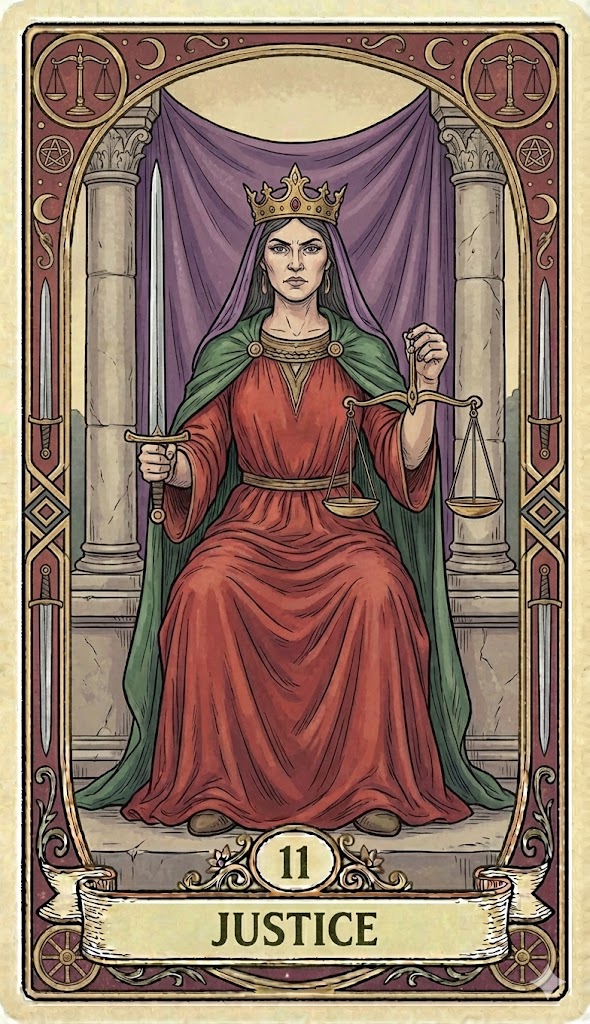
Core Symbolism of Justice
Justice centers on the archetype of balance, honesty, consequence. It helps you look at the situation as a living pattern rather than a simple good-or-bad answer.
Justice is a Major Arcana card, so it points to an archetypal life pattern rather than a small passing mood. It helps you understand the deeper movement behind the situation.
When this card appears, begin with the keywords: balance, honesty, consequence. Ask where these themes are already visible in the question, and where they may be distorted or avoided.
Justice Image and Symbolic Clues
Read the image of Justice by noticing posture, distance, movement, light, and the first detail that attracts your eye. That detail often marks the emotional entrance to the reading.
The card image is not only decoration. It gives the mind a symbolic scene where an abstract issue can become visible and easier to name.
Use the image as a quiet diagnostic tool: what feels inviting, tense, hidden, or unfinished?
Justice Upright Meaning
In an upright position, Justice suggests that this energy can be used with more clarity and maturity. It asks you to notice what is already available and to turn understanding into a concrete, manageable step.
The upright meaning does not mean everything is effortless. It means the energy is more available to be handled with awareness.
The practical invitation is to translate insight into action without demanding that every condition be perfect first.
Justice Reversed Meaning
In a reversed position, Justice may show that the same energy is blocked, exaggerated, delayed, or difficult to receive. This is not a sentence of bad luck; it is a signal to slow down and adjust your response.
Reversal often points to pressure, overuse, avoidance, or a theme that has not yet found a healthy form.
Treat it as an adjustment signal: name what is blocked, then decide whether to slow down, clarify, repair, or set a boundary.
Justice in Love and Relationships
In love and relationships, Justice brings attention to the choices, boundaries, commitment, and honesty inside the relationship.
It does not read another person's mind or make the decision for you. It helps you see the interaction pattern, the spoken and unspoken expectations, and your own role in the dynamic.
For an ambiguous connection, compare feelings with actual behavior. For a long-term relationship, use the card to review the pattern rather than to force a final judgment.
Justice in Work and Career
In work and career questions, Justice highlights career direction, role, responsibility, and the next visible action.
It is useful for checking whether your goal, resources, timing, and responsibilities are aligned.
If you are considering a change, proposal, or collaboration, turn the card into concrete criteria: what outcome matters, what resource is missing, and what action can be taken now?
Justice in Money and Practical Matters
In money and practical matters, Justice points to resource allocation, risk, and the need for a steadier sense of safety.
It should not be used as the only basis for investments or major financial choices. Use it instead to understand your relationship with security, desire, caution, and value.
The useful question is not only what will happen, but how you are currently making decisions around resources.
Justice in Spread Positions
Justice changes meaning according to its spread position. In the past position, it can show a pattern that still shapes the present. In the present position, it describes an active energy. In the future position, it suggests a theme that may become more visible.
As advice, the card asks you to respond to balance, honesty, consequence with maturity. As an obstacle, it may show where the same themes are being misused, suppressed, or avoided.
- Past position: Justice may describe an earlier pattern of balance, honesty, consequence that still shapes the present.
- Present position: this card names the energy that most needs your attention now.
- Future position: this theme may become more visible, so adjust your pace and expectations early.
- Advice position: focus on: Use the card's energy consciously and take one step that is honest, proportionate, and sustainable.
Justice as Self-Reflection
For self-reflection, place balance, honesty, consequence back into your real situation. What feeling is strongest? What fact are you avoiding? What would one gentle but concrete action look like?
Justice becomes most useful when it returns you to agency. It should clarify your choices, not replace them.
A mature reading leaves room for complexity, responsibility, and free will.
Practice After Drawing Justice
After drawing Justice, write down three things: the result you want, the loss you fear, and one small action you can take today.
You can also keep Justice as a daily observation theme. Notice when you move toward its conscious expression, and when you fall into its blocked expression.
The value of the card is not in labeling yourself or others. It is in helping you return to life with more clarity.
Justice FAQ
What does Justice mean?
Justice usually points to themes of balance, honesty, consequence. It is a reflective symbol, not a fixed prediction.
What is the difference between upright and reversed Justice?
Upright usually means the energy is easier to use consciously. Reversed suggests that it may be blocked, delayed, exaggerated, or still immature.
What does Justice mean in love?
In relationship readings, it helps you observe patterns of expectation, closeness, defense, and communication rather than making a final decision for anyone.
What does Justice mean for work?
It points to the pace, responsibility, resources, and choices shaping the current professional situation.
What should I do after drawing Justice?
Choose one small honest action. The card becomes useful when it helps you return to life with clearer attention.